
TRINITY Silver Reference Line
The Mono
Bride
Power Amp
The Magnum Opus
0.00005% THD at 200W
Silence.
Power.
Revelation.
For the first time, you can enjoy the authentic master tape sound in the comfort of your own home.
When a single note is played, every musical instrument produces a series of harmonic overtones; this is known as the harmonic series. Leonard Bernstein provides a very detailed description of the harmonic series in a highly recommended YouTube video. Harmonic Series – Explained
Distortions in audio electronics mask the natural overtone series of musical instruments and singing voices, and destroy the natural sound of the music. Only distortion-free audio electronics are capable of perfectly reproducing the sound of the master tape.
The TRINITY power amplifier is the only amplifier capable of faithfully reproducing the overtone series of every musical instrument and every human voice, as it does not introduce any distortion of its own into the audio signal.
〰
0.00005%
THD at 200W
▥
-160 dB
Noise Floor
▣
432
Output Transistors
Ω
< 2 Ohms
LOAD-independent
◎
8,000,000
Damping Ratio
⌁
> 500 kHz
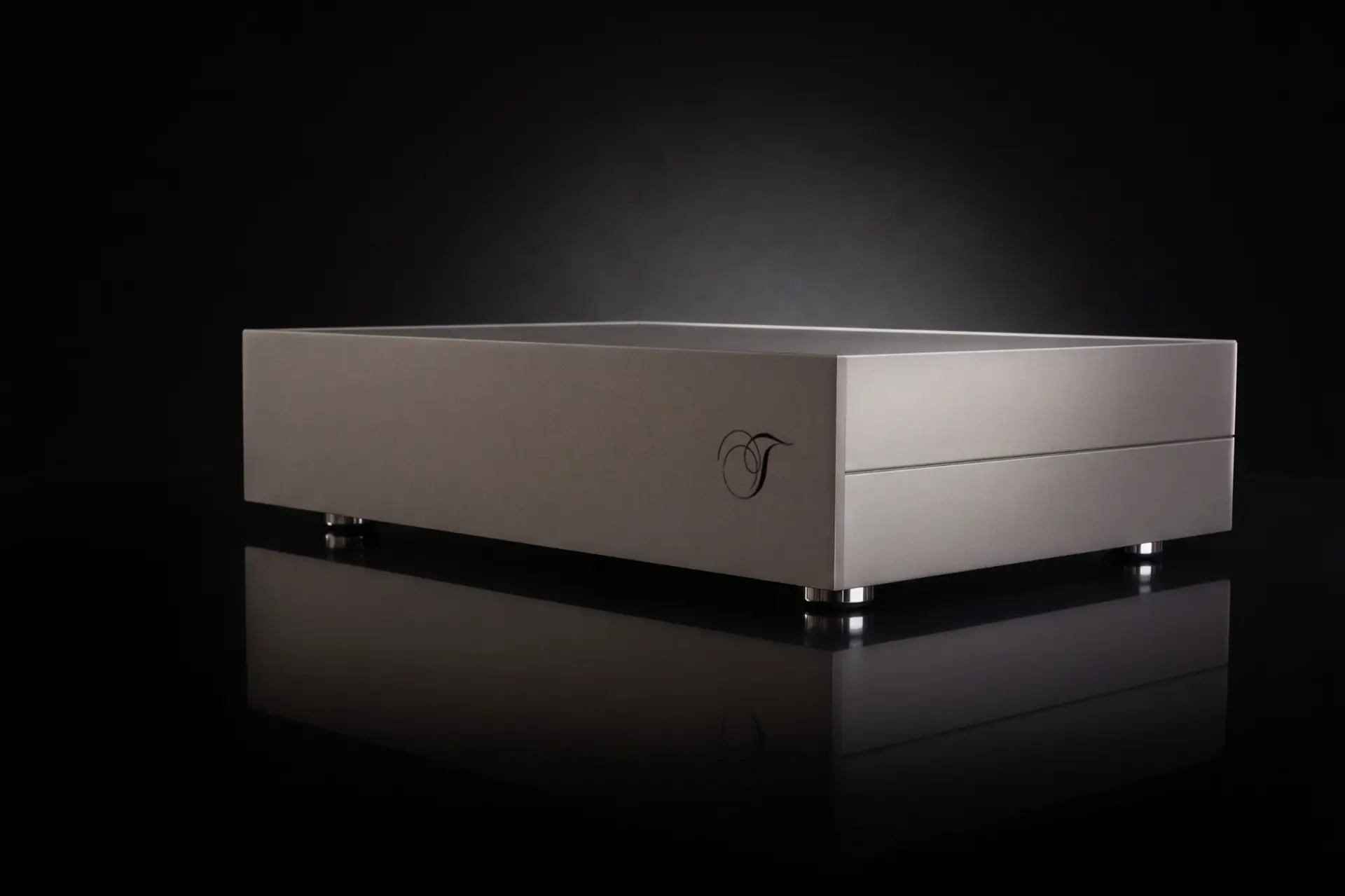
Designed without compromise
Uncompromising quality and reliability are the benchmarks for all our products. With our outstanding new TRINITY power amplifier you can really rejoice in the silence between the notes, because its noise level of
-160dB is at the physical limit of measurability.
This mono power amplifier with its 432 output transistors represents the masterpiece among all power amplifiers, because its previously unattained parameters already border on a technical miracle.
The TRINITY AMP’s unique circuit design delivers a distortion-free output current of up to 27 amperes, enabling it to drive even the most demanding loudspeakers with a minimum impedance of 1 ohm with ease.
As well as the technical specifications that literally catch the eye and make every TRINITY device unique, it is the seemingly minor details which, taken together, make for a technically perfect product.
Another unique selling point is that all printed circuit boards for analogue signals are based on an 8-layer design rather than, as is usually the case, on cheap single- or double-layer designs.
Functionality and technical perfection make TRINITY devices symbols of quality and precision.
As no cable can improve any signal which it is passing (unless it is filtering out some other problem that should not be there) it must be concluded that the best cable is no cable. Moreover, as no amplifier can improve the accuracy of the signal which it is passing, the only conclusion which can be drawn is that the combination of amplifier and cable can only degrade the signal. However, as we must use an amplifier and a cable, art and science are both employed in order to minimise the inevitable degradation.
Loudspeakers, Philip Newell and Keith Holland
Technology & Design
Objectives of an ideal audio power amp
TRINITY deliberately stays out of the race for the highest output power, as this says absolutely nothing – and I mean absolutely nothing – about the actual sound quality.
An ideal audio amplifier should be free from distortion and noise.
Music itself is a bandwidth-limited signal whose upper cut-off frequency does not exceed 100 kHz.
In order to reproduce the finest high-frequency details faithfully, the amplifier’s power bandwidth should extend well beyond this.
Electrostatic loudspeakers such as the Neolith have a nominal impedance of 4 ohms and 0.43 ohms at 20 kHz, which corresponds to a giant capacitive load of 18.5 µF.
Therefore, a power amplifier should provide adequate output current to drive even a load below 1Ohm without any loss of performance.
The power amp should have enough phase margin to drive a 15.8µF load.
Based on the measurement results the TRINITY amplifier can be regarded as an ideal amplifier.
This amp sets new standards for the terms ‘extremely low distortion’ and ‘load-independent’.
Stability & Output Impedance
From the theory we know an amplifier is always stable on all complex loads, if the “open loop” output impedance is zero. Zero is impossible, but we can reduce the output impedance if we use more output transistors in parallel. Therefore 216 pieces of NPN/PNP pairs are working in parallel in each of the TRINITY amplifier.
The phase margin of a power amplifier is the most important parameter of all, as it alone determines which complex loads can be driven before the amplifier becomes unstable and begins to oscillate.
The TRINITY amplifier has a phase margin of more than 60° and is therefore, by design, stable with all conceivable loads. This phase margin is achieved, amongst other things, by the ultra-fast output transistors with a transit frequency above 200MHz, which creates an extremely short group delay of approximately 20 ns.
The output impedance should be as low as possible, as it alone determines how precisely the loudspeaker chassis can be driven – and not, as is often mistakenly assumed, the maximum output power.
Amps with higher damping ratio can control the speaker much better.
The TRINITY amplifier has a simulated output impedance of 1 µOhm at 20 Hz. The output impedance is so low that it cannot be measured; therefore, we must rely on the simulation. This results in a damping ratio of 8,000,000 at 20 Hz.
Why 432 Output Transistors
The 432 output transistors give the amplifier, beside the ultra-low distortion, an excellent phase magin and ensure that the TRINITY amplifier operates stably even with all types of complex loads.
Due to this high phase margin, there is no need for the additional output circuits typically found in conventional amplifiers. Such circuits can audibly impair sound quality.
- There is no need for a damped air coil to make the amp stable on capacitive loads.
- There is no need for a Zobel network to make the amp stable on inductive loads.
- There is no DC protection relay in the output line.
The most neutral Sound
As mentioned in the beginning no amplifier can improve the sound, the only thing an amplifier can do is to minimize the inevitable degradation. The characteristic of the TRINITY AMP does not change neither over the audio frequency range, over the complex load of the speakers nor the sound level. That is exactly what the TRINITY AMP does: it has been designed so that it has no ‘signature’ sound of its own.
When used in conjunction with the other outstanding TRINITY devices, you can, for the first time, enjoy the true analogue master tape sound in your own home.
The 1000W Myth
There is no plausible technical reason to build a 1000-watt amplifier, because the myth that music can demand 1000 watts from an amplifier under normal listening conditions is, of course, technical nonsense. The only thing that determines the amplifier’s output power is the volume control of the preamp — and nothing else.
It is the volume control alone that determines the output power of the amplifier, and certainly not the music. The dynamic range of the music clearly plays no part in this.
The output power is calculated using the formula Power = V²/R, where R is the impedance of the loudspeaker, which can be regarded as constant for the purposes of this calculation. The maximum possible output voltage is set by the volume control.
To put it simply: if the volume control sets the power amplifier’s output voltage to 4 Vrms, the loudspeaker can draw a maximum of 4 W = (4 Vrms)²/4 Ω from the power amplifier, as the output voltage cannot exceed 4 Vrms regardless of the music being played.
Put simply, this means that the 1000W amplifier only delivers 1000 W when the volume control is set to maximum.
Experience TRINITY
Request information about the Mono Bridge Power Amp.